[ARTICLE]
LinkedIn · 2026 · AI teams · Multi-agent dynamics · Organizations
Uses a comic but conceptually serious scenario — two AI agents, a boundary agreement and a touch of jealousy — to reflect on delegated roles, emergent interaction patterns and second-order behaviours inside AI systems.
→ read article
[ARTICLE]
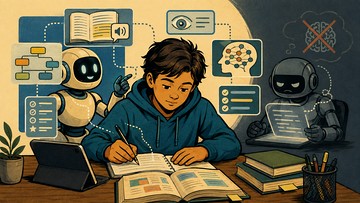
Agenda Digitale · 27 August 2026 · Educational AI · Inclusive learning · Cognitive safety
Examines the difference between assistive use of AI and cognitive substitution for students with specific learning disorders. The point is not to deny support, but to distinguish help from silent replacement of the student’s own mental work.
→ read article
[ARTICLE]
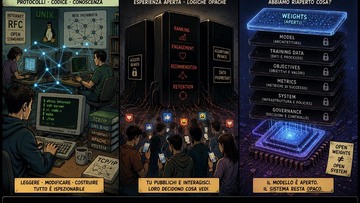
Codemotion Magazine · 26 August 2026 · AI governance · Open source · Verifiability
Argues that open weights are not enough. Meaningful openness in AI requires visibility into data choices, optimization goals, evaluation criteria and governance processes — not just access to the resulting model.
→ read article
[ARTICLE]
Agenda Digitale · 28 July 2026 · Educational AI · Evaluation metrics · AI governance
Explains why exercises completed, time on platform and correct answers are weak proxies for learning. Without open public metrics, vendors end up defining what “educational effectiveness” means for their own systems.
→ read article
[ARTICLE]
Federprivacy · 14 July 2026 · Educational AI · Privacy · Cognitive safety
Applies an accountability mindset to educational AI adoption: schools should define the expected educational benefit before selecting a tool, not pretend that a DPIA alone answers pedagogical questions.
→ read article
[ARTICLE]
Medium · June 2026 · Educational AI · AI tutoring · Learning metrics
Explains the design premise behind Proxima ZSP: an AI tutor should not be optimized simply to output the correct answer, but to preserve and make observable the student’s reasoning process.
→ read article
[ARTICLE]
Formiche.net · 17 June 2026 · Educational AI · Thinking · Design
Presents Proxima ZSP as a concrete design answer to the question of whether AI can help people think. Attribution note: the work is Marco Iannacone’s; the editorial title frames it within a broader cultural discussion involving Prof. Mario Caligiuri.
→ read article
[ARTICLE]
LinkedIn · 9 September 2025 · Artificial intelligence · Future of work · Organizations
Reflects on how AI may reshape organizational structures and the HR function, treating the issue as a transformation of roles, decision flows and distribution of expertise — not merely a story about job automation.
→ read article
[ARTICLE]
Life Is Better After Divorce · 12 June 2025 · Society · Generation X · Human systems
A direct and ironic reaction to a narrative that caricatured Gen X as mediocre. Uses cultural contrast and generational self-awareness to defend a cohort often overlooked between louder stereotypes.
→ read article
[ARTICLE]
Skuola.net · 18 July 2018 · Education · School policy · Inclusive learning
A data-driven reflection on the goals and performance of the Italian school system, touching on inclusion, learning differences and the limits of conventional educational metrics. It provides historical continuity with later work on Educational AI.
→ read article